

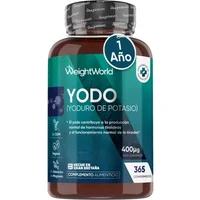
Yodo Natural 150mcg - 365 Comprimidos
HIVITAL 
 Gratis mit Prime
150mcg yodo · 365 tomas
 150mcg yodo · 365 tomas
Wofür ist es gut?

Inhaltsstoff
Mineral esencial para la síntesis de hormonas tiroideas (T3, T4). La deficiencia de yodo es la causa más comun de hipotiroidismo prevenible en el mundo.
La sal yodada es la principal fuente. El kelp puede tener cantidades excesivas e impredecibles. Selenio es cofactor necesario.
 La sal yodada es la principal fuente. El kelp puede tener cantidades excesivas e impredecibles. Selenio es cofactor necesario.
UL: 1100mcg/día. Exceso puede causar tanto hipo como hipertiroidismo. Contraindicado en tiroiditis de Hashimoto activa sin supervisión médica.
 UL: 1100mcg/día. Exceso puede causar tanto hipo como hipertiroidismo. Contraindicado en tiroiditis de Hashimoto activa sin supervisión médica.
Referenzdosis
150-1100 mcg
Produktdetails
EspañaEigenschaften
Günstigere Alternativen
 Günstigere Alternativen

Andere Produkte von Yodo


Wissenschaftliche Evidenz
 Wissenschaftliche Evidenz
Understanding the current situation and risk of environmental contamination by anti-influenza drugs in aquatic environments is key to prevent the unexpected emergence and spread of drug-resistant viruses. However, few reports have been focused on newer drugs that have recently been introduced in clinical settings. In this study, the behaviour of the prodrug baloxavir marboxil (BALM)-the active ingredient of Xofluza, an increasingly popular anti-influenza drug-and its pharmacologically active metabolite baloxavir (BAL) in the aquatic environment was evaluated. Additionally, their presence in urban rivers and a wastewater treatment plant (WWTP) in the Yodo River basin was investigated and compared with those of the major anti-influenza drugs used to date (favipiravir (FAV), peramivir (PER), laninamivir (LAN), and its active metabolite, laninamivir octanoate (LANO), oseltamivir (OSE), and its active metabolite, oseltamivir carboxylate (OSEC), and zanamivir (ZAN)) to comprehensively assess their environmental fate in the aquatic environment. The results clearly showed that BALM, FAV, and BAL were rapidly degraded through photolysis (2-h, 0.6-h, and 0.4-h half-lives, respectively), followed by LAN, which was gradually biodegraded (7-h half-life). In addition, BALM and BAL decreased by up to 47 % after 4 days and 34 % after 2 days of biodegradation in river water. However, the remaining conventional drugs, except for LANO (<1 % after 10 days), were persistent, being transported from the upstream to downstream sites. The LogKd values for the rates of sorption of BALM (0.5-1.6) and BAL (1.8-3.1) on river sediment were higher than those of conventional drugs (-0.5 to 1.7). Notably, all anti-influenza drugs were effectively removed by ozonation (>90-99.9 % removal) after biological treatment at a WWTP. Thus, these findings suggest the importance of introducing ozonation to reduce pollution loads in rivers and the environmental risks associated with drug-resistant viruses in a
Background Dietary supplements (DSs) are widely used to improve health and nutrition, but challenges related to misinformation, safety, and efficacy persist due to less stringent regulations compared with pharmaceuticals. Accurate and reliable DS information is critical for both consumers and health care providers to make informed decisions. Objective This study aimed to enhance DS-related question answering by integrating an advanced retrieval-augmented generation (RAG) system with the integrated Dietary Supplement Knowledgebase 2.0 (iDISK2.0), a dietary supplement knowledge base, to improve accuracy and reliability. Methods We developed iDISK2.0 by integrating updated data from authoritative sources, including the Natural Medicines Comprehensive Database, the Memorial Sloan Kettering Cancer Center database, Dietary Supplement Label Database, and Licensed Natural Health Products Database, and applied advanced data cleaning and standardization techniques to reduce noise. The RAG system combined the retrieval power of a biomedical knowledge graph with the generative capabilities of large language models (LLMs) to address limitations of stand-alone LLMs, such as hallucination. The system retrieves contextually relevant subgraphs from iDISK2.0 based on user queries, enabling accurate and evidence-based responses through a user-friendly interface. We evaluated the system using true-or-false and multiple-choice questions derived from the Memorial Sloan Kettering Cancer Center database and compared its performance with stand-alone LLMs. Results iDISK2.0 integrates 174,317 entities across 7 categories, including 8091 dietary supplement ingredients; 163,806 dietary supplement products; 786 diseases; and 625 drugs, along with 6 types of relationships. The RAG system achieved an accuracy of 99% (990/1000) for true-or-false questions on DS effectiveness and 95% (948/100) for multiple-choice questions on DS-drug interactions, substantially outperforming stand-alone LLMs like GP
— Recent developments in robotic demanufacturing raise the potential to increase the cost-efficiency of recycling and 3 recovering resources from Waste of Electrical and Electronic Equipment (WEEE). However, the industrial adoption of robotic 4 demanufacturing for mixed WEEE streams requires tailored instructions for every product model. Considering the large variation 5 in product models, it is not expected to be feasible in the coming decade to rely only on computer vision technologies to define the 6 tailored instructions required for robust and time-efficient robotic demanufacturing. Therefore, the presented research developed a 7 generic retrieval system named You Only Demanufacture Once (YODO) based on content-based image retrieval (CBIR) to identify 8 the product model and retrieve product model-specific demanufacturing instructions. The system compares the visual features 9 represented on a color image of the WEEE with a database of known descriptions representing previously imaged WEEE to find 10 a match or to figure out whether the analyzed product model is new to the system. The performance of YODO is evaluated with a 11 case study for laptop model identification, where a large dataset is created including 4089 images of a representative laptop waste 12 stream. The results demonstrate a top-1 retrieval mean average precision (mAP) of 93.75%. After running YODO on 3600 laptops, 13 the system learned 1079 unique product models, and the presented results show an 85% chance that the next laptop presented to 14 the system is already registered in the database, allowing the retrieval of relevant information for robotic demanufacturing. This 15 corroborates that a fast learning rate can be achieved, allowing a YODO system to support the robotic demanufacturing by making 16 prior product-specific learnings available.
This research investigated the historical changes in basin-scale rainfall characteristics and their spatial distributions in the Lake Biwa and Yodo River Basin. Nine rainfall indices including two general and seven extreme rainfall indices and the probable rainfall according to 50- and 100-year return periods were evaluated based on the data gathered from 61 rain gauge stations. The regionalization of the rainfall indices and probable rainfall was then examined using spatial interpolation via the Kriging method. The results of the spatial analysis for the rainfall indices showed that there is a potentially high risk of extreme rainfall events and pluvial floods, particularly in the northern, western, and southern areas. The 50- and 100-year probable rainfall has historically increased in the north through to the western area of the basin. The return periods of the 50- and 100-year rainfall events decreased in the northern area of Lake Biwa and the western area of the basin. The findings of this research suggest that the local flood management plan needs to be updated depending on the regional differences in extreme rainfall characteristics. In basins/areas with sparsely distributed rain gauge stations, regionalization can provide useful information as part of local flood management planning.
El objetivo del presente trabajo fue evaluar el efecto de la pandemia COVID-19 sobre la disponibilidad y accesibilidad de sal yodada en la ciudad de Salta a nivel del mercado minorista previo a y en el nuevo contexto. Para llevar a cabo este estudio se realizó un estudio multietápico, descriptivo y comparativo con una muestra estadísticamente representativa y sistemática de los 321 barrios de Salta capital. Se realizó la compra del envase de sal alimentaria en febrero/2020, enero/2021, abril/2022, estos dos últimos bajo protocolos de prevención. Se determinó el yodo por titulación con tiosulfato de sodio, considerando valores referenciales internacionales que la presencia de “>95 % de las sales de grado alimentario deben estar yodadas en el rango establecido por legislación, a nivel de producción y en el mercado”. Los resultados mostraron que las sales regionales son las de mayor oferta en los tres monitoreos. La totalidad de etiquetado presenta la leyenda “Sal enriquecida con yodo según Ley 17259/69” y sus registros normativos con gran variabilidad en la fecha del vencimiento. En el 2020, 2021 y 2022 el nivel de yodo varió tanto en las sales nacionales como regionales, las sales aptas fueron del 59,3 %, 29,2 % (p=0,0003234) y 41,9 % respectivamente. Sin yodo: 5,5 %, 4,2 % y 3,2 %. En 2021 todos los barrios ofrecieron sales no aptas. Una marca regional ocupa mayoritariamente el mercado minorista. En el contexto sanitario COVID-19, los contenidos de yodo en la sal para el consumidor descendieron marcadamente respecto a la situación pre pandémica, indicador de alerta por los efectos para la salud de la población y futuras generaciones.
Möchten Sie wissen, ob dieses Produkt das Richtige für Sie ist?
Machen Sie den personalisierten TestSuplr kann eine Provision für Käufe über die Links auf dieser Seite erhalten. Das ändert weder deinen Preis noch unsere Empfehlungen. Als Amazon-Partner verdient Suplr an qualifizierten Verkäufen.