

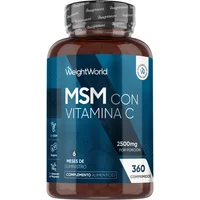
Salengei Rejuvenal MsmPro 180 tabletas
Salengei
 Spedizione gratuita
A cosa serve?

Componente
Metilsulfonilmetano, compuesto orgánico de azufre. Antiinflamatorio y antioxidante. Puede mejorar dolor articular, recuperación muscular y salud de piel.
Dosis típica 1-3g/día. Bien absorbido. Puede combinarse con glucosamina y condroitina. Efecto gradual en 2-4 semanas.
 Dosis típica 1-3g/día. Bien absorbido. Puede combinarse con glucosamina y condroitina. Efecto gradual en 2-4 semanas.
Generalmente muy seguro. Puede causar molestias GI leves. Pocos datos en embarazo.
 Generalmente muy seguro. Puede causar molestias GI leves. Pocos datos en embarazo.
Componenti coperti (2)
Dose di riferimento
1000-6000 mg
Dettagli del prodotto
Caratteristiche
Altri prodotti di MSM



Evidenza scientifica
 Evidenza scientifica
Background: Accurate dietary assessment is essential for estimating habitual and acute exposures. This study compared a 7-day food diary (7dFD) and repeated 24-h dietary recall (2×24hDR) for habitual and acute intake. Habitual fish and n-3 PUFA estimates were evaluated against whole-blood EPA and DHA, and acute intake of fish, rye bread, and coffee was explored using operational indicators. Methods: In a within-subject comparative design, 120 Danish adults aged 18–60 years completed both methods. Fish and n-3 fatty acid intakes were compared with whole-blood EPA and DHA. Usual fish intake from 2×24hDR was estimated using the Multiple Source Method (MSM) with Food Propensity Questionnaire (FPQ) data. Acute intake was assessed using single-day, consumption-day, single-meal, maximum-day, and meal-weighted estimates. Results: EPA, DHA, total fish, and fatty fish intakes estimated from the 7dFD and MSM-adjusted 2×24hDR correlated with biomarkers r = 0.23–0.46. Supplement inclusion improved EPA and DHA correlations (r = 0.26–0.59). The unadjusted 2×24hDR identified fewer fish consumers than the 7dFD (63% vs. 88%), whereas FPQ-based modelling identified 97%. Acute intake estimates varied by method and definition: the 2×24hDR produced higher short-term and upper- percentile estimates, while the 7dFD produced more stable distributions. Limitations include modest sample size, upper-percentile uncertainty, and non-equivalent supplement assessment. Conclusions: In this adult convenience sample, the 7dFD provided more stable habitual intake estimates, whereas the 2×24hDR produced higher short-term and upper-percentile estimates under the applied operational acute-intake definitions. These findings are context-dependent and should not be taken as evidence that either method is generally superior.
Background/Objectives: Methylsulfonylmethane (MSM) is found in natural foods and used as a dietary supplement due to its anti-oxidant and anti-inflammatory properties. We hypothesized that MSM can induce dentin formation in dental pulp tissue, and this study evaluated the potential of MSM to induce dentin formation. The effect of MSM on mineralized dentin formation was examined using cultured dental pulp cells. Methods: Dental pulp cells were isolated from rat lower incisors using sequential enzymatic treatment and cultured with 25 mmol/l MSM (MSM group) for 14 days. Cells cultured without MSM were examined as a control (Cont) group. Cells were stained with alizarin red (AR). Total RNA was isolated from cells for analysis of Alp, Dentin sialophosphoprotein (Dspp), Bone Gla protein (Bgp), Wnt10a, Wnt6, Axin2, and Runx2 mRNA expression using real-time polymerase chain reaction (PCR). Results: On day 14 of culture, formation of mineralized nodules was detected in cell layers using AR, and the staining intensity in the MSM group was much higher than that in the Cont group throughout the culture period. Compared with the Cont group, MSM also stimulated mRNA expression of the Alp, Dspp, and Bgp genes, which are associated with odontoblast differentiation. Similarly, Wnt10a, Wnt6, and Axin2 expression was also much higher in the MSM group than in the Cont group. Conclusions: These results indicate that MSM activates the Wnt canonical pathway and stimulates odontoblast differentiation of rat dental pulp cells, ultimately resulting in dentin-like nodule formation. The results of the present study suggest an application for MSM as a new biomaterial for vital pulp therapy.
The widespread use of methylsulphonylmethane (MSM) as a dietary supplement highlights the need to understand its fundamental behaviour in aqueous solutions. In this paper, we investigate changes in the MSM band shape as a function of its concentration using Attenuated Total Reflection FTIR (ATR-FTIR) spectroscopy. ATR spectra may be complicated by significant optical artefacts arising from refractive index changes. These can be misinterpreted as genuine vibrational shifts, leading to erroneous conclusions. Here, we systematically investigate aqueous MSM solutions using three different internal reflection elements. Applying a rigorous ATR correction procedure, validated by transmission measurements and PARAFAC (Parallel Factor Analysis) analysis, decouples physical phenomena from optical distortions. The corrected spectra reveal a crucial finding: the primary effect of MSM is not a shift in the sulphone band position, but a distinct change in its shape. This result, supported by DFT (Density Functional Theory) calculations, indicates increased heterogeneity of local hydration environments and demonstrates the criticality of proper ATR correction.
Aging is associated with detrimental bone loss, often leading to fragility fractures, which may be driven by oxidative stress. In this study, the outcomes of comparing the differences among young, adult and aged C57BL/6J mice found that the trabecular bone volume was significantly lower in the aged mice compared to young mice, and the bone characteristics were significantly correlated with the oxidative status. To counteract the adverse effects of aging, methyl sulfonyl methane (MSM), a stable metabolite of dimethyl sulfoxide, was used to supplement the drinking water (400 mg/kg/day) of the aged mice (73 weeks old) for 8 weeks. The MSM supplementation improved the maximum load, bone microarchitecture, and mRNA levels of osteocyte-specific genes in the tibia. Furthermore, MSM reduced the serum level of the C-terminal telopeptide of type I collagen, a marker of bone resorption, and downregulated the mRNA levels of genes related to osteoclast proliferation and activity. MSM also decreased the levels of pro-inflammatory cytokines in both the serum and bone marrow. Importantly, the MSM-treated mice exhibited an enhanced antioxidant status, characterized by increased glutathione peroxidase (GPx) activity and glutathione concentration in plasma, erythrocytes and bone marrow. These improvements were linked to the activation of the nuclear factor E2 related factor 2 (Nrf2) pathway and its downstream antioxidant gene expression, including that of superoxide dismutase and GPx. These findings suggested that age-related bone loss is closely tied to oxidative stress, and MSM supplementation effectively reverses bone loss by mitigating oxidative stress-mediated bone resorption.
Simple Summary Unfit horses performing exercise are especially at risk for oxidative damage and inflammation within skeletal muscle. Methylsulfonylmethane (MSM) is a commercially available dietary supplement that has been shown to reduce oxidative damage and inflammation caused by exercise in men. The hypothesis that MSM supplementation would function as an antioxidant and anti-inflammatory following exercise was tested in unfit adult horses. Horses were supplemented with or without MSM for 30 days, followed by a standardized exercise test (SET). Blood and skeletal muscle biopsies were collected to measure the markers of oxidation and inflammation. The results offer a conflicting story for MSM in regard to its antioxidant abilities. As an anti-inflammatory, MSM-supplemented horses had a greater number of exercise-responsive genes by comparison to the controls, indicating a role for MSM in the inflammatory process. Overall, the results suggest MSM supplementation for improved anti-inflammatory responses in skeletal muscle following exercise.
Vuole sapere se questo prodotto è adatto a Lei?
Faccia il test personalizzatoSuplr può ricevere una commissione sugli acquisti fatti tramite i link di questa pagina. Questo non cambia il prezzo che paghi né le nostre raccomandazioni. In qualità di Affiliato Amazon, Suplr riceve un guadagno dagli acquisti idonei.